What is flashing on a flat roof?
6 min readReece Francis, Roofer
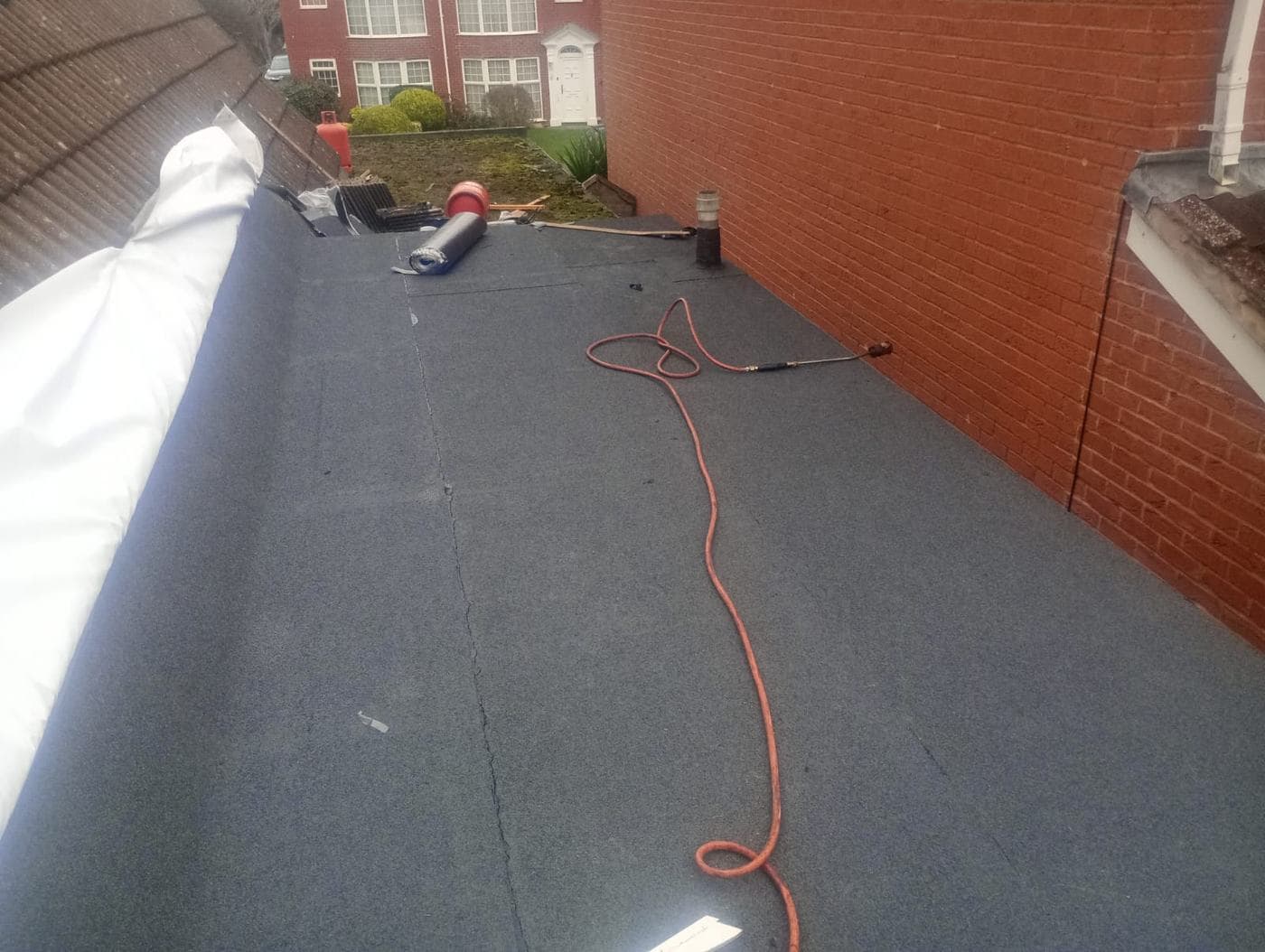
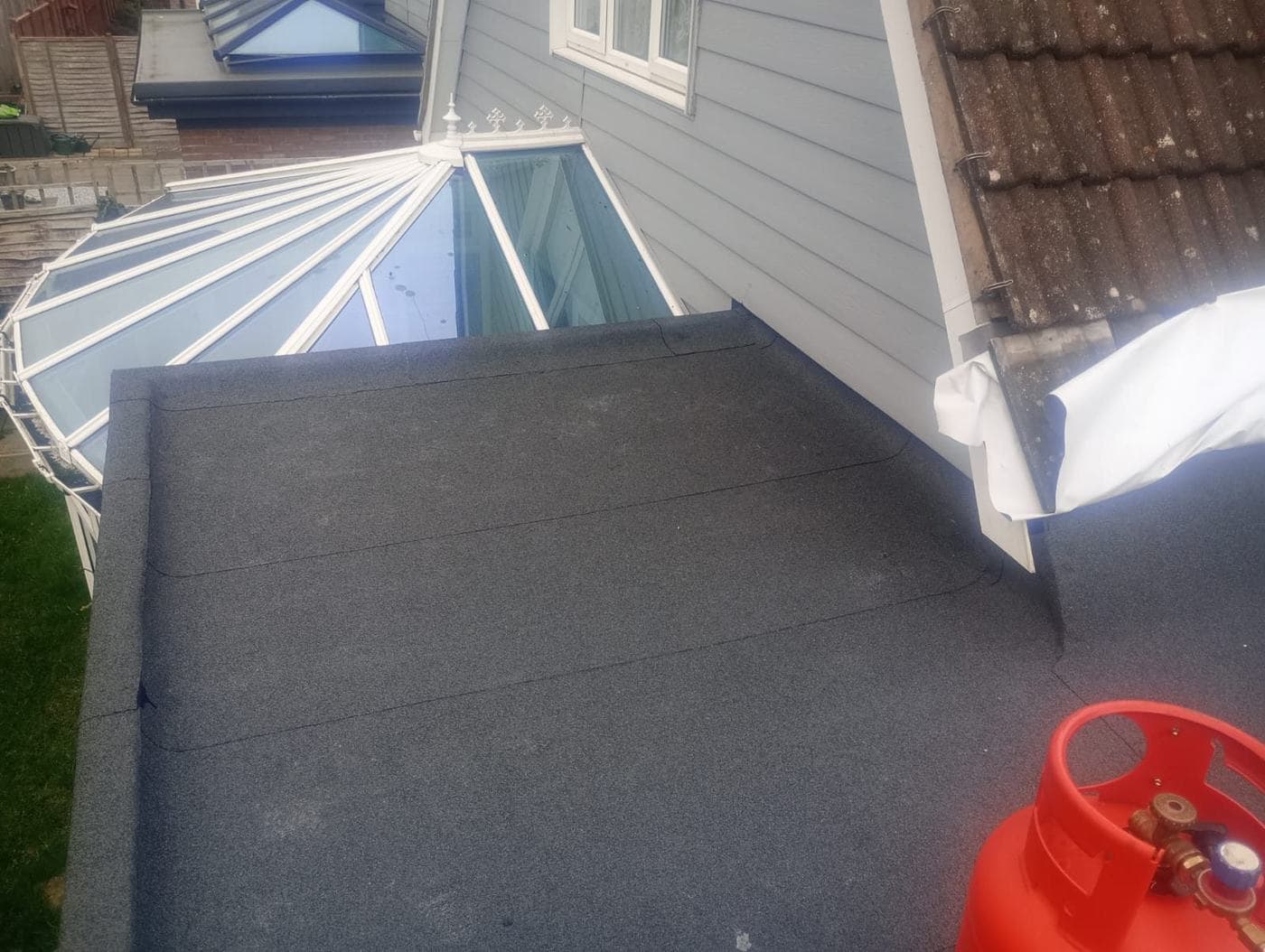
Flashing on a flat roof is the waterproofing at every point where the roof covering stops against something else. That means the wall of the house where an extension roof meets it, a parapet, the kerb around a rooflight, a pipe or vent coming up through the deck, and the open edges where rain runs off into the gutter. Most of the time it is two pieces working together. The roof covering itself is turned up the wall to form an upstand, and a separate cover flashing, usually lead, is tucked into a mortar joint in the brickwork above and dressed down over the top of that upstand, so rain running down the wall is carried out over the roof instead of behind it.
It matters more on a flat roof than on a pitched one, because water leaves a flat roof slowly. A small fault at a junction gives standing water time to find its way in, and once it is under the covering it can travel, so the damp patch inside often shows up some distance from the real fault. Damaged upstands where the roof meets a wall are among the faults we see most often on flat roofs. The general picture of what flashing on a roof does applies here too, but a flat roof has its own details, and they fail in their own ways.
The parts of flat roof flashing
Upstands. Wherever the roof meets a wall, a rooflight or a vent, the covering is turned up the vertical face rather than simply stopping at it. Manufacturers' guidance puts the minimum height at 150mm above the finished roof surface, the figure the British Standard for flat roofs has long set, and IKO's guidance on upstand heights applies it to abutments, rooflights and service vents alike. The height is there because water lying on the roof can reach the junction, and heavy rain splashes up off the surface as well.
Cover flashings. An upstand on its own leaves a top edge that rain running down the wall would get behind. The cover flashing closes it off. On brickwork it is usually a strip of lead set into a raked out mortar joint, wedged and pointed in, then dressed down over the top of the upstand. Code 4 lead is the usual minimum for flashings, as Designing Buildings explains, because it is thick enough to resist the splits that expansion and contraction cause in thinner sheet.
Kerbs, pipes and vents. A rooflight usually sits on a raised kerb, and the covering is dressed up and over it in the same way as at a wall. Pipes and vents through the deck need a sleeve or collar sealed to the covering. These are small details on a big roof, and they are exactly where water tends to get in.
Edges. Where the roof runs off into a gutter, an edge trim or drip carries the water clear of the fascia so it drops into the gutter instead of tracking back underneath. Edges that have lifted are another of the common faults on flat roofs.
Where a flat roof meets a pitched one. On many extensions the flat roof runs straight into the tiled slope of the main house. Here the covering is taken up under the bottom courses of tiles, or a lead apron is dressed over the junction, and it is a detail that needs care because both roofs are sending water to the same spot.
Why flat roof flashing fails
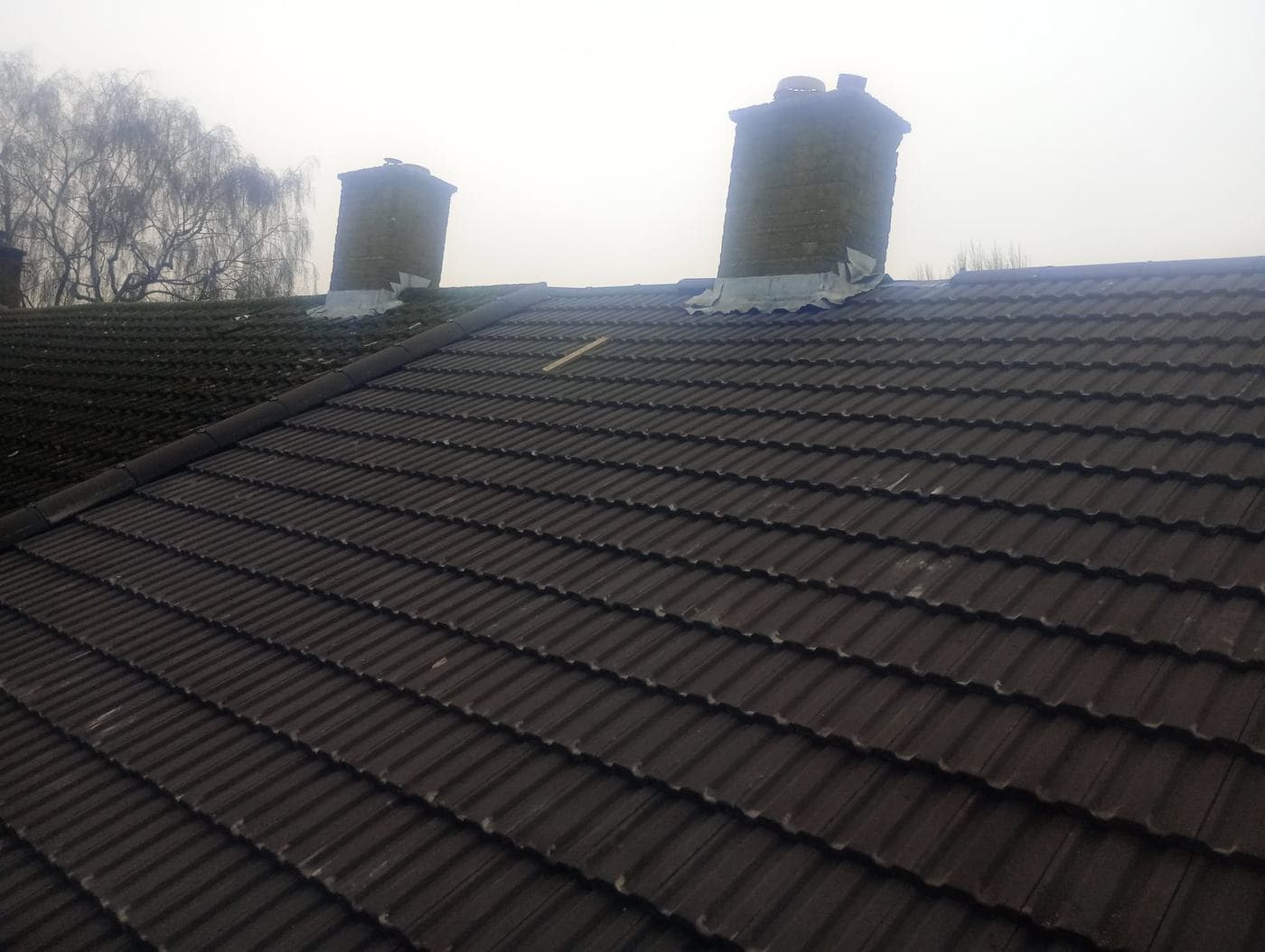
Lead moves. Lead expands and contracts as it warms and cools, so pieces that are too long or fixed too tightly can split over the years. The mortar holding the flashing into the brickwork can crumble and let the top edge pull out of its joint, and high winds can lift lead that was never fixed securely. The cause is often the same one behind a leaking chimney, where lead is doing a similar job.
The covering cracks at the angle. The point where the covering turns up the wall is under strain every time the roof heats and cools. Felt roofing in particular goes brittle with age, and once it does, the angle and the laps are where it gives way.
The upstand is too low. An upstand that stops well short of the usual height can be overtopped by standing water or splashing in heavy rain, especially where a later layer of covering has raised the roof surface without the upstand being raised with it.
Water lies against the junction. A flat roof is never truly flat. The British Standard for flat roofs was revised in December 2025, and Bauder's summary of the changes notes that it now states plainly that the minimum completed fall on most flat roofs is 1 in 80 and that backfalls are not acceptable under any circumstances. A roof that holds water against a wall is asking its flashing to sit under water, and no flashing does that for long.
Sealant instead of a proper detail. A bead of mastic along the top of an upstand, or a patch of sealant over a split in the lead, can stop a drip for a while. It does not move with the roof the way a properly dressed flashing does, and it cracks and lets go, usually in the first hard winter.
Signs the flashing is the problem
- Damp or staining on a ceiling or wall next to where the flat roof meets the house.
- Lead that has lifted, cracked or come away from the brickwork.
- Gaps where the mortar holding the flashing has fallen out of the joint.
- The covering split, blistered or lifted at the foot of the wall.
- Water lying against the wall after rain has stopped.
- A leak that only appears in heavy or wind driven rain.
None of these proves where the water is getting in, because water under a flat roof covering travels. That is why the leak is traced first, by looking at the whole roof, before anything is repaired.
Repair or renew
Many flashing faults are repairs. A lead cover flashing that has pulled out of its joint can be refixed and the joint repointed, which is the kind of job our brickwork and repointing and lead work and flashing services cover. A split length of lead can be replaced. A cracked upstand is repaired to suit the covering, with felt patched, fibreglass repaired with fresh resin and matting, and rubber repaired with a membrane patch and the right adhesive. In our experience, replacing failed flashing works better than repeatedly sealing small gaps, because it restores a proper waterproof barrier.
Do not let anyone talk you into a new roof because the flashing has failed on a covering that is otherwise sound. The flashing can be put right on its own. Replacement starts to make sense when the covering has gone brittle across the whole roof, when water pools over large areas, or when leaks keep coming back in new places, which are also the signs that decide whether a flat roof is reliable enough to keep repairing. If the roof is re-covered, building regulations come into it. The Planning Portal's guidance on work to an existing roof sets out when re-covering needs a building control application, and a larger job can also bring in a requirement to improve the insulation. Ask who is dealing with that before the work starts.
If water is already coming through, we offer emergency roof repairs with a 24 hour callout.
Getting your flat roof flashing looked at
Rated Roofers and Builders has over 25 years in roofing and building across Surrey and South London. We are based in Wimbledon, so the flat roofs on the extensions, garages and dormers around SW19 are close to home, and we cover the rest of the area from there. We come and look at the roof before we price anything, tell you what we found and whether it needs a repair or a new roof, and give you a written quote that is free with no obligation. If you have damp where a flat roof meets the house, contact us or get a free quote.
Need this doing
Flat Roofs