Why Roofs Leak in Winter
6 min readReece Francis, Roofer
On this page (7)
Roofs leak in winter because winter is the season that finds every weakness at once. Four things are happening together. Water gets into small cracks and freezes, expanding by roughly nine per cent and widening the crack a little more each time. Wind drives rain sideways and upwards, into places ordinary rain never reaches. Nothing gets a chance to dry out between one downpour and the next. And the roof space itself is cold enough for household moisture to condense on it, which produces damp that looks exactly like a leak and is not one.
The most useful thing to hold onto is that winter very rarely creates a fault. It exposes one that was already there. A hairline crack in a tile, a lifted lap of flashing or a length of pointing that had started to go are all perfectly capable of keeping the weather out in July. Put them through a fortnight of freezing nights and a named storm and they stop coping. That is why the leak arrives in January and why it always feels sudden.
Freezing water is what actually does the damage
Water expands as it turns to ice, and roofing materials have no give in them to absorb that. A crack too fine to see takes on a small amount of water, that water freezes overnight, and the crack opens fractionally. It thaws the next day, takes on slightly more water, and freezes again. Repeat that through a cold snap and a flaw you would have struggled to find in October is a visible gap by February.
This is why a cracked tile is worth taking seriously rather than leaving until spring. It is also why moss matters more than it looks. Moss holds water against the tile surface and into the joints, so a mossy roof going into a cold spell is carrying far more freezable water than a clean one.
The same process works on mortar. Chimney pointing, bedding mortar under ridge tiles and the cement fillets still found on plenty of older properties all soak up water and all break down under repeated freezing. Once mortar has gone soft and crumbly it is no longer keeping anything out.
Wind-driven rain goes where ordinary rain cannot
A pitched roof works by shedding water downwards over a series of overlaps. That is a very good system for rain falling more or less straight down. It is a much weaker system for rain being pushed horizontally, or even upwards, by a gale.
Wind-driven rain gets under the tail of a tile, tracks up a lap, works into the joint between a chimney and its flashing, and finds any gap in pointing on an exposed elevation. This is why so many winter leaks show up around chimney stacks, which stand proud of the roof and take weather from every direction, and why a leak often appears only when the wind is from one particular quarter and stays dry the rest of the time.
The UK storm season opens at the start of September and runs through the winter, with the Met Office naming a storm jointly with Met Éireann and the Dutch service KNMI whenever one is forecast to cause medium or high impacts. You can follow the named storms as they are issued. If a leak appears during a named storm and then stops, it has not fixed itself. It is waiting for the next one from the same direction.
Nothing gets the chance to dry
Summer rain falls on a roof and is gone within hours. Winter rain falls on a roof that is already wet, in short days with low sun and little warmth, and the whole structure stays saturated for weeks at a time.
That matters because most roof coverings tolerate getting wet and drying out. What they tolerate far less well is staying wet. Timber battens and rafters that never dry begin to hold moisture, mortar stays soft, and small defects that would shed a summer shower simply give up under continuous load. It is also why a slow winter leak often does more damage than a dramatic summer one. It runs for weeks before anybody spots the ceiling.
A good number of winter leaks are not leaks at all
This is the single most useful thing in this article. A significant share of the winter callouts we attend turn out to be condensation rather than water coming in from outside, and the two are told apart quite easily once you know what to look at.
Condensation appears on cold clear nights, often with no rain at all. It shows as an even film of moisture or beads of water across the underside of the roofing felt over a wide area, rather than a defined wet patch. In a hard frost you will sometimes see frost or droplets sitting on the points of the nails coming through the felt, which is a giveaway, because a leak does not decorate every nail in the roof evenly. It is usually worse above bathrooms and kitchens, and it often comes with a musty smell and black mould speckling on the rafters.
A genuine leak behaves differently. It follows rainfall, sometimes with a lag of an hour or two. It produces a defined stain that grows from a point. It leaves tide marks. It is very often worse with wind from one direction. And it tends to be traceable back up the slope to something specific.
Getting this right matters because the fixes have nothing in common. A leak needs the roof repaired. Condensation needs the roof space ventilated properly and moisture from the house kept out of it, and no amount of work on the tiles will touch it.
Where winter leaks actually start
On the housing stock around Croydon, Sutton, Wimbledon, Bromley and Epsom, the same handful of places come up again and again.
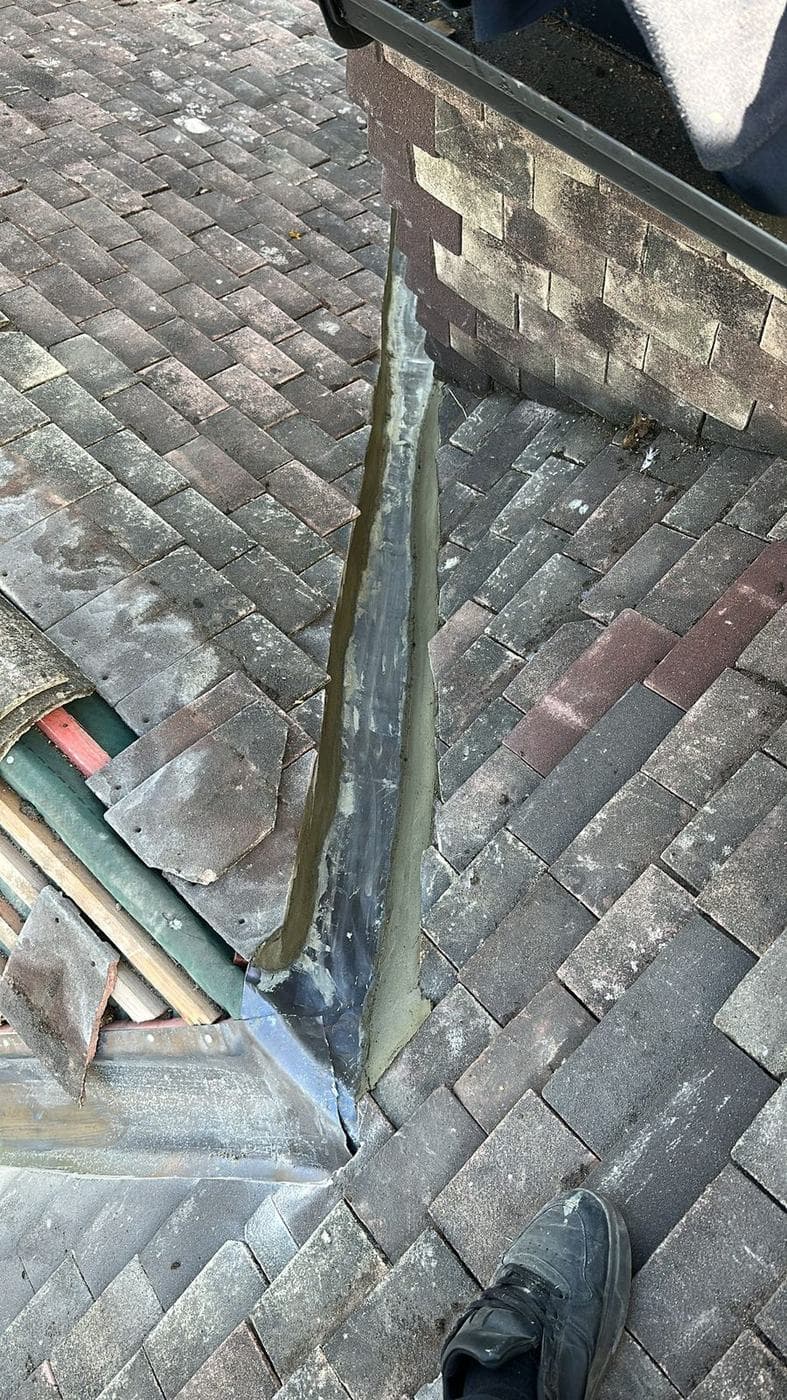
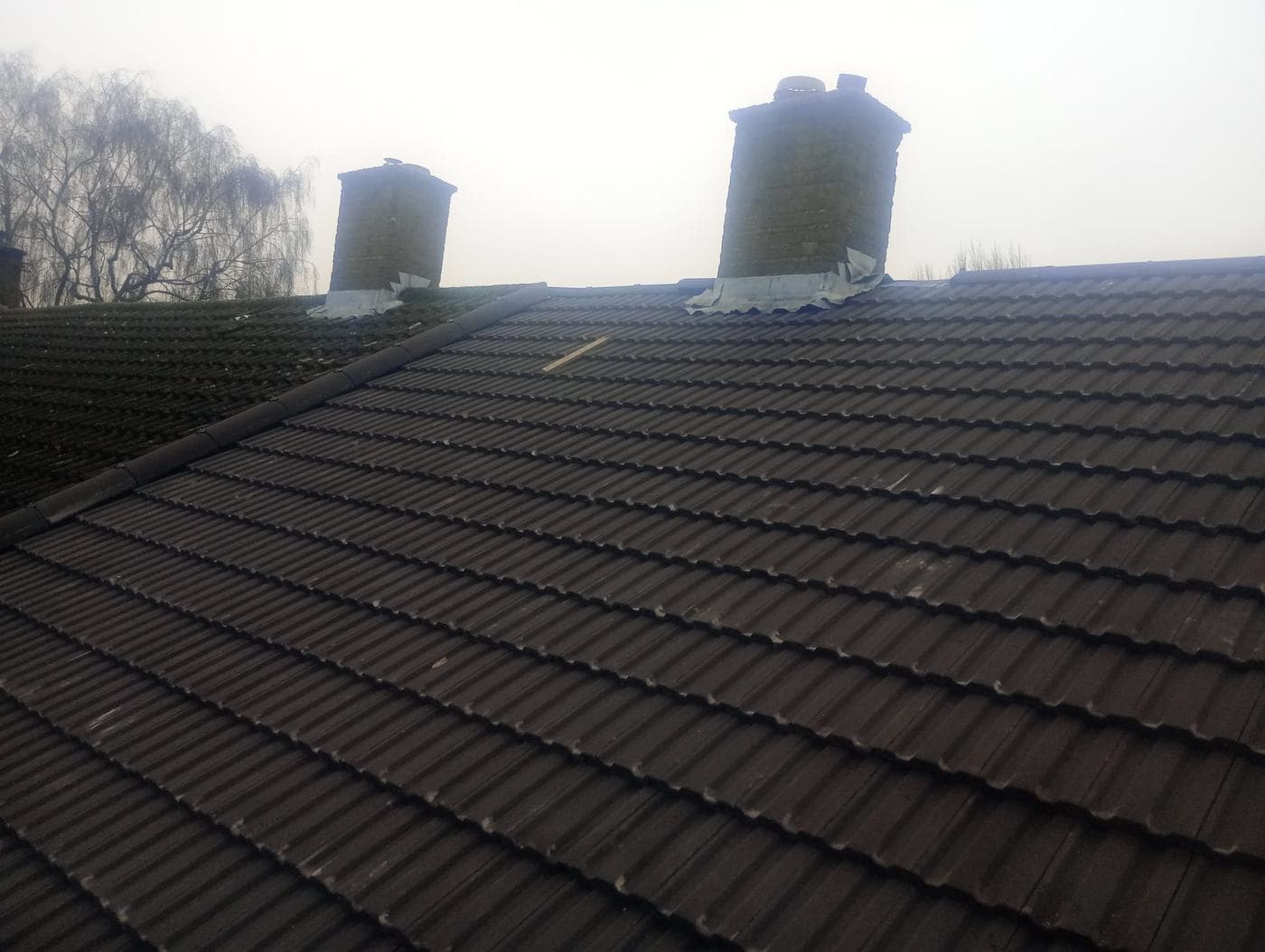
Chimney stacks and their flashings are the most common by a distance. Valleys between two slopes come next, particularly on terraces where a valley is shared with next door and neither owner has looked at it in years. Then rear slopes, which nobody sees, where a slipped slate or tile has been letting water past since autumn. On properties with a rear extension, the abutment where the flat roof meets the main wall is a regular offender, and so is the junction between a flat roof and the pitched slope above it.
Failed pointing on an exposed gable belongs on that list too, because saturated brickwork carries water inwards without any hole being involved. That is a job for brickwork and repointing rather than for the roof covering, and it is regularly misdiagnosed. There is more on the usual causes of a roof leak across the year, but in winter these are the ones that dominate.
Finding the source when one starts
In our experience, tracing a winter leak from inside the loft while it is actually raining works better than starting on the roof because water enters at one point and lands somewhere else entirely, so the stain on the ceiling is almost never underneath the fault. Water runs along the top of a rafter, sometimes several metres, before it finds somewhere to drop. Go up with a torch during rainfall, find where the water is running rather than where it is pooling, and follow it back up the slope. We have found entry points a good four metres from the ceiling stain more than once.
What not to do is get on the roof. A wet, cold, possibly frosted pitched roof is genuinely dangerous, and a slipped tile does not become more urgent than a fall. Put a bucket down, move what you can, photograph the ceiling for your insurer, and get someone insured to look at it.
What to do once you have one
A winter leak needs stopping, then diagnosing properly, and those are two separate visits more often than people expect. Temporary protection in a storm is about limiting damage. The permanent fix usually waits for a dry enough day to work safely.
Rated Roofers and Builders have been roofing across Surrey and South London for over 25 years, covering Croydon, Sutton, Wimbledon, Bromley, Epsom, Kingston upon Thames, Reigate, Redhill and Banstead. We are fully insured with public liability cover, Google Guaranteed and listed on Checkatrade, all our work carries a company guarantee, and we run a 24 hour emergency callout for exactly this, because winter leaks do not keep office hours.
Most of what we deal with in January is roof repairs to things that were visible in September, and a fair share is chimney repairs to stacks that had been shedding mortar for a year. If you would rather find out before the weather does, you can get a free quote for a look over the roof while it is still dry enough to do properly.
Need this doing
Roof Repairs
Leaks, slipped tiles and storm damage traced and fixed.