How do you fix a leaking garage roof?
5 min readReece Francis, Roofer
You fix a leaking garage roof by finding where the water is getting in and then repairing to suit the covering and how much of it has failed. A single split or a lifted edge on an otherwise sound felt roof is a patch. A covering that has gone brittle all over, or one that keeps leaking in new places, is re-covered. If the boards underneath have gone soft, they are replaced first, because a new covering on a rotten deck fails with it. Before any of that, find out what the roof is made of, because an older garage with a corrugated sheet roof may be asbestos cement, which is fragile and needs different handling altogether.
Many garage roofs are flat, and on older garages the covering is often felt. It is the traditional covering, still common on older extensions and garages, cheap to lay but prone to going brittle with age, with its laps the usual place to give way. A garage roof is also easy to forget, so a small fault can be left long enough to soak the deck.
First, what is the roof made of?
Felt. A dark mineral or sanded surface laid in strips with overlapping joints, usually over timber boards.
Rubber or fibreglass. Newer re-covers are often EPDM rubber, a single sheet with few or no joints across the main area, or fibreglass, a hard resin surface. Both repair differently from felt.
Corrugated sheets. Grey ridged sheets bolted to timber or steel purlins. On an older garage these are often asbestos cement. Reigate and Banstead Council's guidance on asbestos lists asbestos cement among the materials used in shed and corrugated garage roofs, and its advice for material in good order is to leave it alone, because trying to remove it is what creates the dust. Do not drill, cut, scrape or jet wash it, and have it tested before anyone works on it.
Tiles. Some garages, particularly ones built with the house, have a pitched tiled roof. Those leak and are repaired in the same way as the main roof, as part of ordinary roof repairs.
Whatever the covering, never walk on a garage roof to look for the leak. The Health and Safety Executive says all roofs should be treated as fragile until a competent person has confirmed otherwise, and its page on fragile surfaces puts fibre-cement sheets and rooflights at the top of the list. Falls through fragile roofs account for 22 per cent of fatal falls from height in construction, and a rotten timber deck can give way just as suddenly. Those are not the only risks of DIY roof repairs, but they are the most serious.
Where garage roofs leak
- Splits, cracks and blisters in the covering. Felt cracks as it ages and blisters where moisture is trapped underneath.
- Lifted edges and laps. Wind gets under an edge or a joint that has lost its bond, and rain follows it.
- The junction with the house. Where an attached garage roof meets the house wall, the covering should turn up the wall with a flashing over it. When the upstand cracks or the flashing on a flat roof pulls away from the wall, this is where the water gets in.
- Water pooling. A dip where the deck has sagged holds water after every shower, and standing water finds any weakness in the covering.
- The gutter. A blocked or missing gutter at the low edge lets water back up under the edge trim. Blocked outlets and downpipes are among the faults we see most often on flat roofs, and clearing or refixing the guttering is often part of the fix.
- Moss and debris. Leaves and moss hold water against the covering and block the fall to the gutter.
On a flat roof the drip inside is often some way from the fault, because water travels under the covering before it finds a way through. That is why the whole roof is looked at, and the leak traced, before anything is repaired.
Patch, overlay or re-cover
Patching. A local split, blister or lifted edge on a covering that is otherwise sound is a repair. Felt is patched, fibreglass is repaired with fresh resin and matting, and rubber is repaired with a membrane patch and the right adhesive. The outlet and gutter are checked at the same time, because a roof that cannot drain will fail again.
Overlaying. On a felt roof that is tired but still dry underneath, a new layer of felt can sometimes go over the old one. It only works over a sound, dry deck, and it is not the answer where water is already lying or the boards have softened.
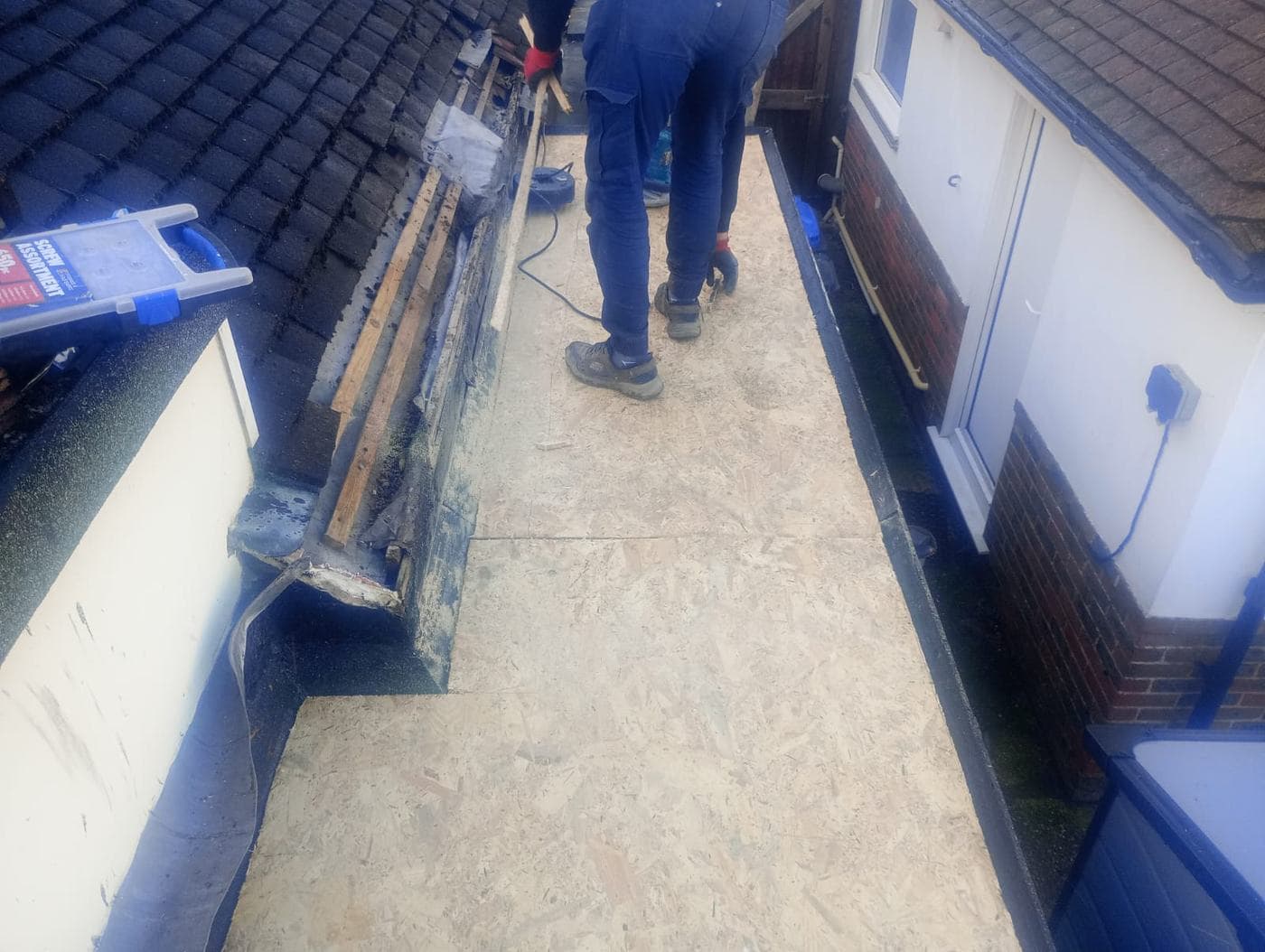
Re-covering. Replacement makes more sense when the covering has gone brittle across the whole roof, when water pools over large areas, or when leaks keep coming back after repairs, because by then each patch is only buying time. The old covering is stripped, any soft or rotten boards are replaced, as on the job in the photograph above, and the new covering goes on. That is also the moment to sort out a poor fall, so water heads for the gutter instead of lying in the middle. Felt, rubber and fibreglass each have their place, and how long each lasts is a large part of whether flat roofs are reliable at all.
Re-covering can need building control approval. The Planning Portal's guidance on work to an existing roof sets out when an application is needed, and it is also needed if a new covering would add 15 per cent or more to the weight of the roof covering. Ask who is dealing with it before work starts.
When not to spend money
Not every garage roof needs a new covering. If the felt is sound apart from one split, it needs a patch, not a new roof. If the garage is only used for storage and the roof is asbestos cement in good condition, leaving the sheets alone may be the right answer, with any leak dealt with at the fixings or the edges by someone who knows how to work around fragile sheeting safely. And if the damp turns out to be condensation on the underside of a cold roof rather than rain getting in, re-covering will not cure it, so it is worth knowing what causes roof leaks, and what only looks like one, before you book anything.
Getting a garage roof looked at
Rated Roofers and Builders has over 25 years in roofing and building across Surrey and South London. We are based in Wimbledon, so the flat roofs on the extensions, garages and dormers around SW19 are close to home, and we work in felt, EPDM rubber and fibreglass on flat roofs right across the area we cover. We come and look at the roof before we price anything, tell you what we found and whether it needs a repair or a new covering, and give you a written quote that is free with no obligation. If your garage roof is letting water in, contact us or get a free quote.
Need this doing
Roof Repairs